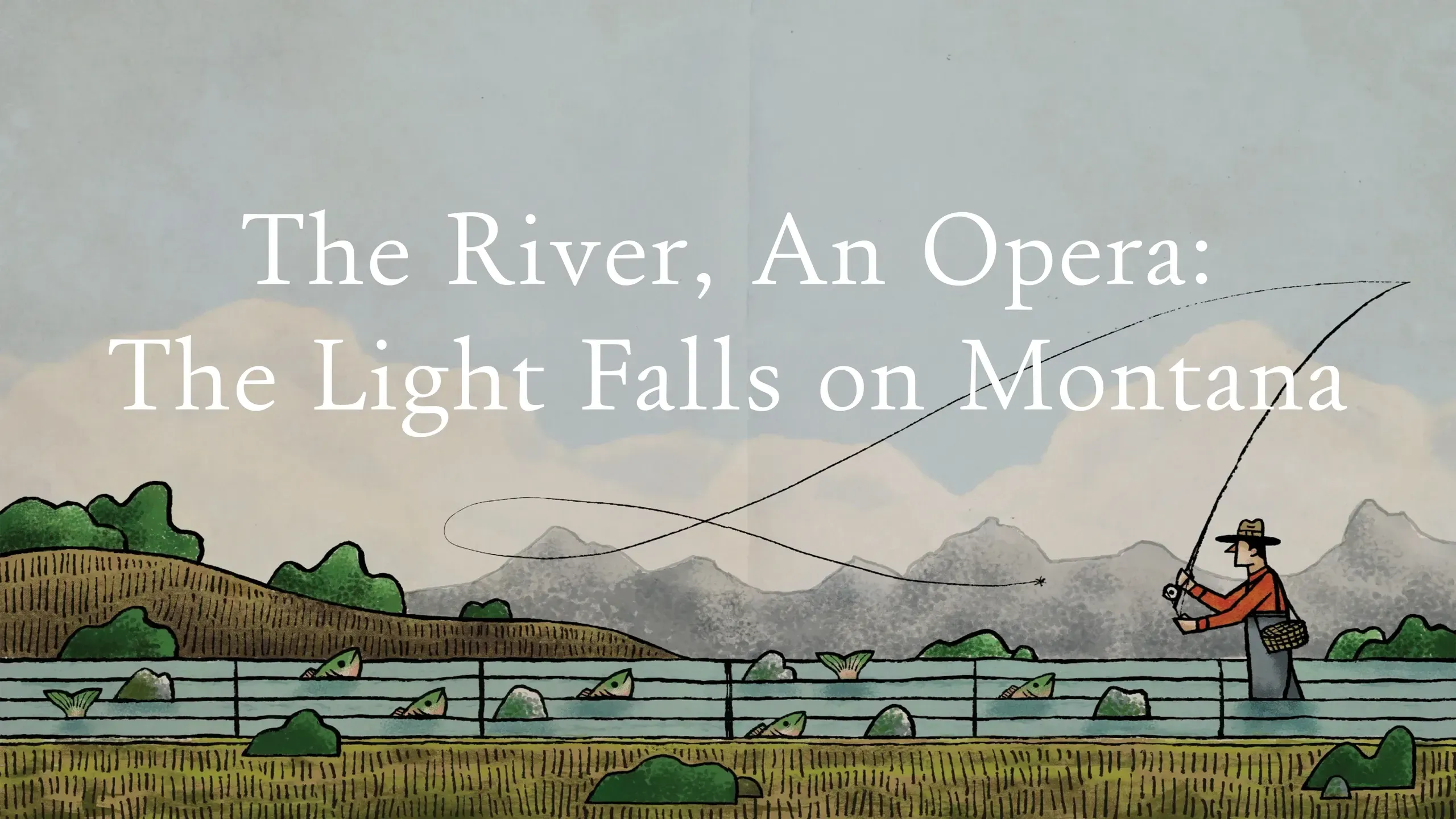
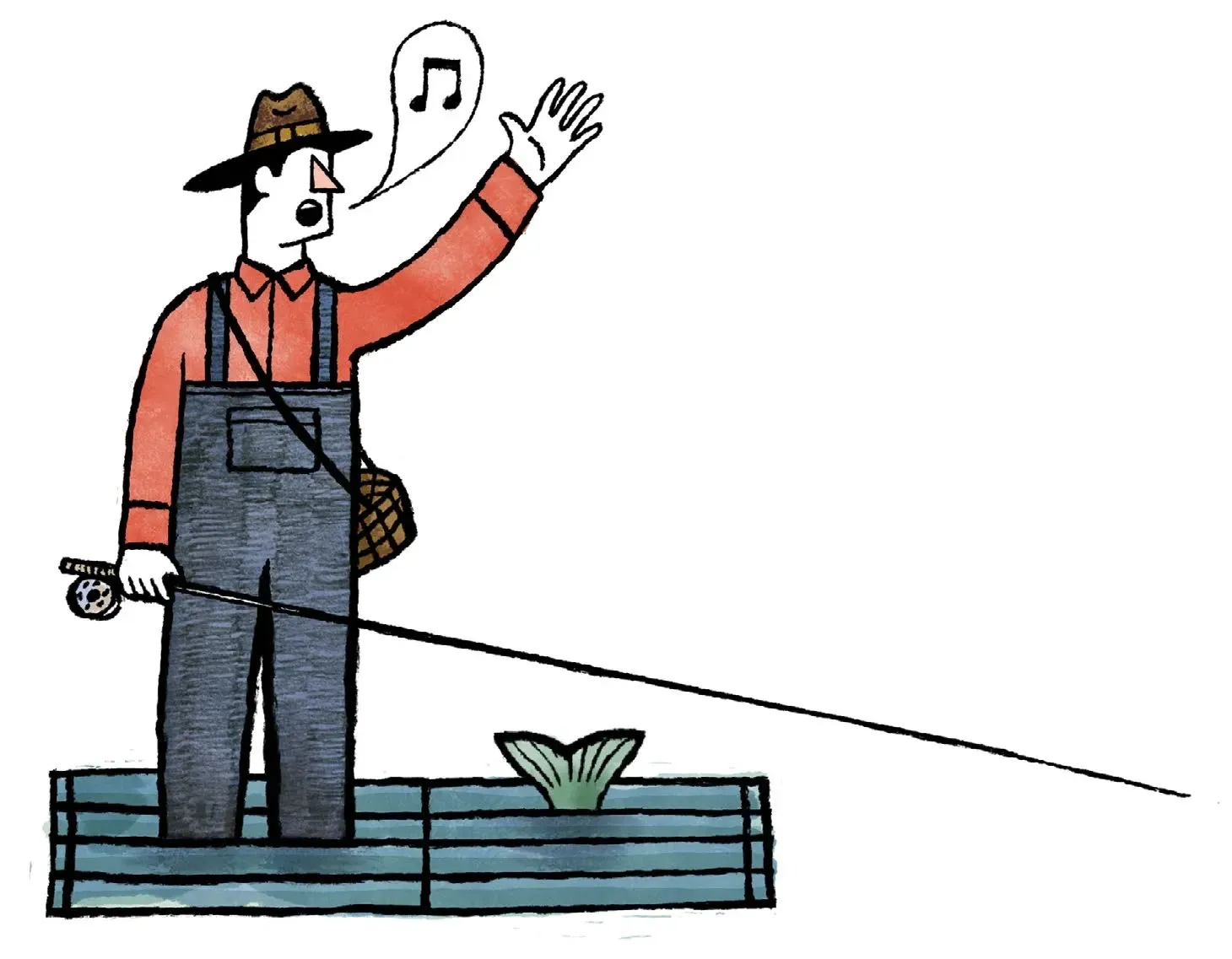
Words by Rick Bass | Illustration by Seth Neilson
We know the beginning by rote: “In our family, there was no clear line between religion and fly fishing.” We examine and re-examine it, as if it is a sacred text.
It’s not a book about fishing, however, but about family and place. It’s what makes Norman Maclean’s novella such an enduring work, what made it such a great film, and what now, in the words of Opera Montana Artistic Director Michael Sakir, gives it “the makings of the next Great American Opera.” Says General Director Susan Miller: “It’s such a great feeling to be able to create something so positive for the community at a time when so many, many things feel the opposite.”
A River Runs Through It is Opera Montana’s first commissioned work. The nonprofit had the option to work with other production organizations but chose to take it on fully themselves, in large part to get it right for the most important audience of all: Montana. As Robert Redford and his team did with the 1992 film, Opera Montana met numerous times with Maclean’s family before developing the project. Playwright Matt Foss—formerly a fire ecologist with the Montana Dept. of Fish, Wildlife & Parks—initially envisioned the novella as a play. But when Maclean’s family suggested it was better suited for an opera, and asked Foss if he knew of anyone who could execute that, he gave a resounding yes: Opera Montana. Under the guidance of Sakir and Miller, Foss joined composer Zach Redler and librettist Kelley Rourke in a collaboration each describes as unlike any other. “Collaboration, like love, can be tough,” says Redler—yet the entire creative team calls it a transcendent experience from the start.

As with other sacred texts, each reader pulls something unique to their own journey even as larger themes proceed explicitly: that those who need help most are least likely to ask for or accept it, and that Montana’s wild open spaces act as a lodestone for healing. Redler describes the story simply as “struggling with love, and struggling with family.”
I’ve heard it said that no one lives in Montana because they have to; that all who are here are here by choice, not necessity; that one could almost always make more money elsewhere. One of the most poignant moments in the story is when Norman gets a job that entails moving to Chicago, while Paul stays, informing him that he’ll never leave Montana. Of course in a way it’s Paul who ultimately leaves—and yet it’s Norman who, even from Chicago, keeps Montana alive through his storytelling and memories.
Painter Clyde Aspevig met with the Opera Montana team before painting the poster they commissioned. Beyond pursuing the river’s light, Aspevig was struck by the strong female presence the opera will amplify. “I chose to use the warmth and luminosity of the evening sky as a symbol of the women’s dedication to their family,” he says. “The sunset casts a soft, warm, backlit glow which embraces the entire landscape. The palette of gray greens and warm purples suggests a melancholy that permeates the book, ending with the death of Paul, and how the family dealt. The brushwork, soft edges, and texture of the paint represent the complex emotions, and a somewhat blurred vision of reality. The only hard edge in the painting is the large rock on the far bank, which is Paul.”
Redford’s team, including writers and co-producers Bill Kittredge and Annick Smith, focused on the light as well. As Paul’s drinking and gambling escalate in the film, the river becomes even more luminous: its shapes and movements shadowed by the sinuous grace of the casts. The film gave the light center stage. Opera Montana intends to give that same role to sound, and song.
What are the characteristics of a foundational work? I’m not sure portability across generations is requisite. A foundational work can serve as a point of inflection in its time, redirecting the relentless flow of a culture—and whether by an inch or a mile may not matter. Change has been effected upon a living system, like a boulder placed in the headlong flow of energy. The change oxygenates the river further as it resumes its journey, more complex and more beautiful.
Maclean’s novella is portable across generations. But how to transfer a river across time? The best we can do is protect a river. But this also means protecting the mountains that are the river’s birthplace, and the rumpled land along either side of the river, and the animals that travel to and from it, and the towns that spring up alongside. Rivers, like forests, remind us that we are all in this together.
The opera has seven characters, none of whom is the character of Mabel, Paul’s Cheyenne girlfriend. She appears briefly in the novella, not like a ghost or a thread, but a seed. She’s absent from the opera’s telling, so that foundation of Montana’s story remains unexamined here. But that isn’t Maclean’s work, or the opera’s; it’s ours.
We in Montana know that light is essentially a kind of music, and that sound is a kind of light—waves moving at different speeds. And geology, Maclean reminds us, is the slowest light wave, and slowest sound wave of all. But in art as in fly casting, in compression lies power, and we can’t talk about A River Runs Through It without speaking of song.

“There are at least 27 beautiful, slow, heartbreaking arias that did not get written,” says Rourke. “It takes a really long time to sing things,” she says, “and you want to leave room for the music to do the storytelling.” There will be a bluegrass tune in the opera, as well as a part for a guitar. Foss describes how he loves “listening and finding patterns in the work.” And he’s fond of quoting Richard Ford: “If loneliness is the disease, storytelling is the cure.”
Rourke’s not a fly fisher, but she has studied the craft carefully. “It’s about making contact with the Other, right? You can study and learn and practice, but at the end of the day, there’s still this impenetrable Other, right?”
We’re a little closer to that Other in Montana, and in our rivers. And now, this fall, if for but a mid-September afternoon, in the opera.
Rick Bass, the author of more than 30 books, has been awarded the Montana Governor’s Arts Award and lives in the Yaak Valley. Working with The Montana Project, he has helped curate several festivals that feature the Black Ram guitar.
Seth Neilson is a multidisciplinary creative director, illustrator, and photographer living in Utah. He returns to Montana as often as he can to make sure the trails, mountains, and rivers haven’t shuffled around too much in his absence.