Words by Eric Ladd
Photos by Isaias Miciu Nicolaevici
Patagonia River Guides embrace legacy and landscape.
Nearly 6,000 miles separate Bozeman, Montana, from Trevelin, Argentina. Two days of airports, dusty roads and the slow unfurling of the world as one mountain range gives way to another. From the Gallatin Range to the foothills of the Andes, you do not just travel across continents, but toward the essence of something.
From the air, the scene below looks almost unreal. A mosaic of gin-clear rivers curls through the steppe like glass ribbons. In many bends and pools, trout hang suspended in turquoise light, shadows shifting beneath the surface. For an angler, it is almost incomprehensible.
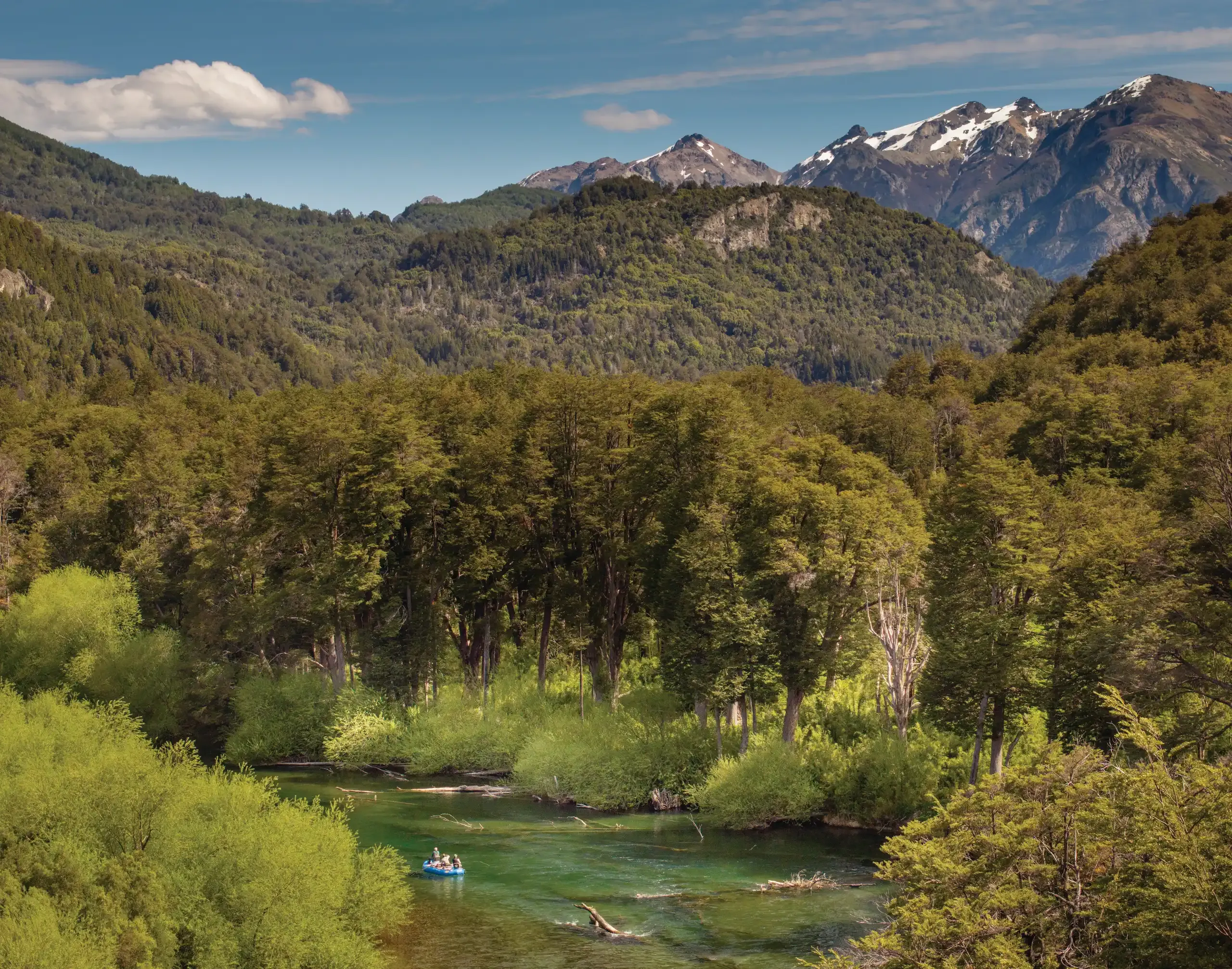
And then we land. We stand knee-deep in the legendary Arroyo Pescado, a spring creek so clear it feels sacred. It’s the kind of water that humbles even seasoned anglers. It’s a river with a decades-long reputation, famous for the moments it creates.

I’m a fisherman from Montana, not born there but shaped by its rivers, and I stand in the current with eyes locked on a monster rainbow sliding along a weed bed. Years of casting in the Northern Rockies has taught me what good water looks like—but nothing could have fully prepared me for Patagonia.
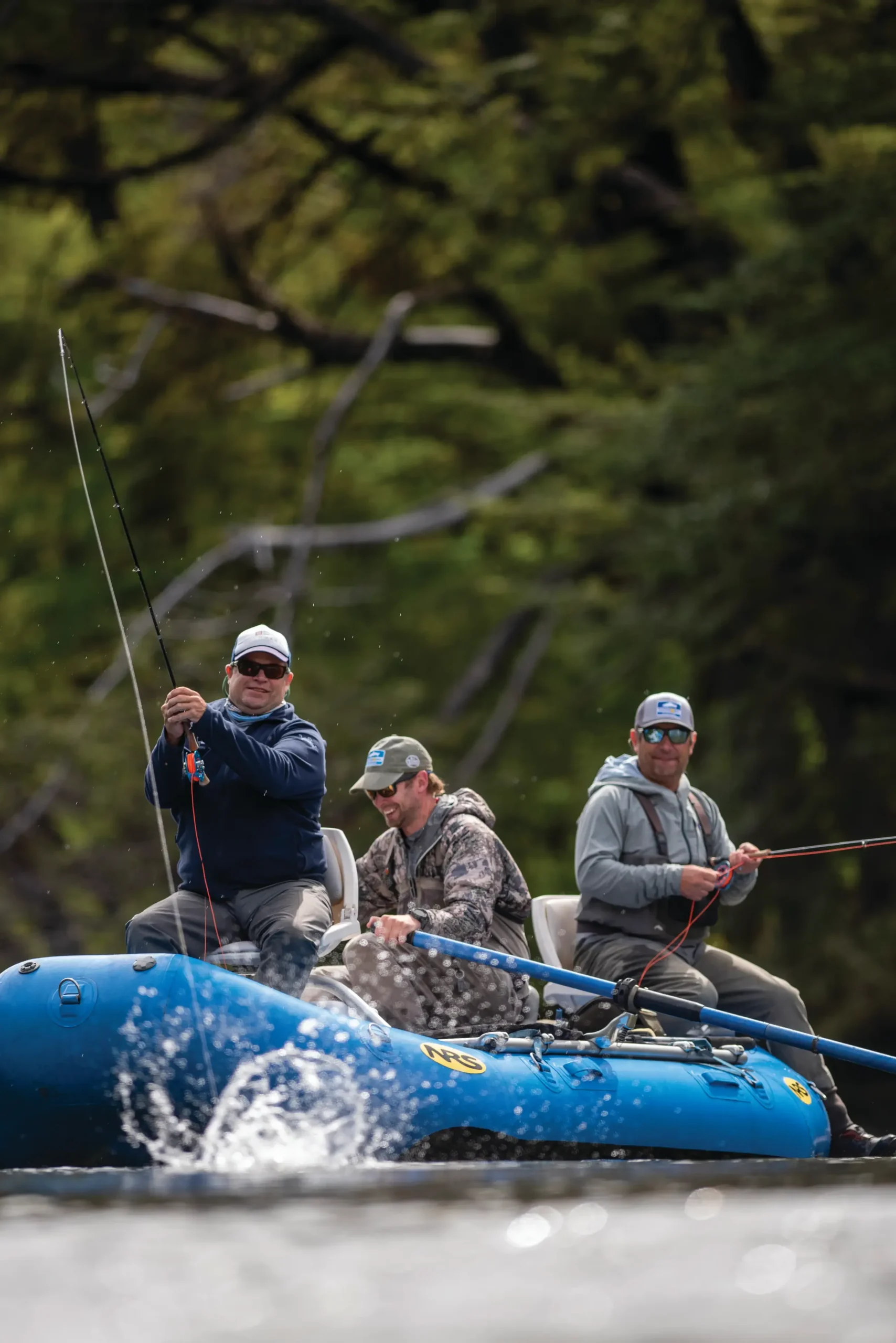
A breath. A cast. The perfect loop. A tiny beetle on 4X, landing softer than a thought. The drift is clean, the take sudden. An explosion of silver and sunlight as the fish cartwheels into legend.
Our guide, Alejandro Jones, watches quietly from the bank. As my line tightens and the reel begins to sing, he leans toward me and whispers almost as if to himself.
“This … this is the essence.”
In that electric second, line tight and lungs full, the world narrows to river, trout and sky, and everything makes sense.

In that electric second, line tight and lungs full, the world narrows to river, trout and sky, and everything makes sense.
Years of guiding and wandering eventually led to a question that would not let go: What if there was still a frontier for fly fishing, a place where rivers ran wild, fish grew old and unpressured, and adventure still felt real? Patagonia answered.
The dreamers
Rance Rathie and Travis Smith grew up in Montana’s Ruby Valley, fishing the Big Hole, Beaverhead, Ruby and Jefferson rivers until they knew their rhythms by heart. Patience came before algebra. Fly tying before first dates. The Madison showed up in their lives now and then. The Yellowstone rarely, simply because it was far away.
In the early years, Rathie and Smith worked for an Argentine outfitter, learning the region river by river. Then came the 2001 Argentine economic collapse, and with it a hard lesson. At the end of the season, there was no money; they had worked an entire year without pay.
They returned to Montana bruised but not broken, and while Smith went back to college and Rathie considered engineering, the dream of Patagonia would not release its grip. Rathie built a sample brochure, named the vision Patagonia River Guides (PRG), and pitched it to his best friend.
To start the company, they each pulled $10,000 from cash-advance credit cards, emptied what little savings they had left, and committed fully. They drove south with everything they owned packed into their trucks: rafts, oars, frames, tables, chairs, rods, reels, waders, boots.
Rathie invented a foldable raft and storage system that fit into the back of the truck, eliminating the need for trailers and allowing access to waters no one else could reach efficiently. That system remains uniquely PRG.
The partners set up camp in Trevelin, a Welsh-settled valley at the end of a dirt road, and began building something from nothing without a blueprint or safety net. All they had was grit, a strong belief in what they were doing and the solidity of their friendship.
Carving a lodge into the landscape
The land did not make it easy, with unrelenting winds, dirt roads that dissolved into pastures, and a landscape that always rose abruptly into mountains—but that was the point.
After seven years of building the business, things came full circle. They purchased the remnants of the old Trevelin Lodge, which was in dire condition. It would have been easier to tear it down and start over, but the location was unrivaled, the dead center of the fly-fishing universe in the region. Every building was painstakingly remodeled and what emerged is now considered one of the most polished and respected fly-fishing lodges in the world.
Every wall, every piece of reclaimed wood, every river map pinned in the bar carries the Montana code they brought south: Work hard, guide harder and leave things better than you found them.
Every wall, every piece of reclaimed wood, every river map pinned in the bar carries the Montana code they brought south: Work hard, guide harder and leave things better than you found them.
Today, PRG’s home waters stretch far beyond Trevelin, north toward San Martín and Junín de los Andes, and south into the Río Pico Valley, a system of spring creeks, small rivers and freestones that merge into something extraordinary. They guide in Tromenco, Las Mulas, Campamento, Las Pampas and Nielson. The Río Pico itself meanders east before falling into Chile, the valley dotted with dozens of lakes. To the north, the Corcovado and Tigre drainages hold some of the largest brook trout in the world in settings so remote they feel untouched by time.
Here, guides are not hobbyists but multigenerational anglers, children of gauchos and ranchers who turned fly fishing into a profession. They speak the language of wind and current and become a part of the surrounding landscape. Their knowledge is inherited.
PRG also quietly built a guide apprentice program, PRG University—which has trained more than 100 young guides—where they are taught English, how to drive, professionalism, equipment maintenance, safety, hospitality, efficiency and eventually guiding.

Among them is Alex Roberts, now the lead guide at the Lodge at Trevelin. He started alongside his sister Melony, waiting tables at PRG’s first leased lodge, earned his place on the water, and now leads the program his father, John Roberts, helped shape years earlier.
Patagonia’s remoteness and Argentina’s fierce protection of its rivers have created something rare for anglers who are lucky enough to visit their waters, and every week, guests say the same things.
“This is how Montana and Idaho used to be.”
“Wouldn’t it be amazing if our rivers could rest and recover?”
Here, they are allowed that grace, and that too is part of The Essence.
A kingdom of rivers
From the terrace of the Lodge at Trevelin, water flows in every direction. Few places on Earth offer this kind of variety. Drive west into the Valdivian rainforest and sight-fish emerald rivers. Stay in the mountain valley and lose yourself beneath rugged Andean peaks. Head east into the Patagonian steppe, where desert dominates.
The Arroyo Pescado, Chubut, Gualjaina, Tecka, Corintios, Arrayanes, Rivadavia, Frey and Corcovado rivers each carry their own rhythm, offering something for both seasoned anglers and first timers. While one day demands technical precision, the next invites long drifts and open water. Every guest is touched by the place.

And when the fishing ends, another ritual begins with riverside cookouts of Argentine beef hamburgers and Malbec, tenderloin dinners and traditional Asado. The PRG kitchen, led by Martin Astorga, operates with the same finesse as the guiding operation, with elements of farm-to-table, from-scratch, organic vineyards, greenhouses, laying hens and composting, ensuring everything is fresh, local and gives back to the earth.
This is what sets Patagonia River Guides apart; it’s not just one river or one lodge, but a kingdom.
The vineyard dream
Dinner at the Lodge at Trevelin carries its own rhythm. Firelight fuels conversation and the merry clink of glasses.
The vineyard outside began as a landscaping project, until it became something more. In their first year, vines died, irrigation was rebuilt, frost systems engineered, and an old garage was crafted into a winery. The first vintage was produced in 2018 through sheer persistence. The name Contra Corriente, Against the Current, fits perfectly.
PRG planted the first vineyard in the valley, among the southernmost in Argentina, pioneering a wine region few believed possible. Climate shifts, glacial retreat, and Pacific influence temper the valley, and Contra Corriente helped place Trevelin on the global wine map.


They did not hire a winemaker until after they had made, bottled and labeled their own wine. Eventually, the right people found them, and with the help of technological upgrades they built a winery equal to any in the world. Contra Corriente is currently chasing a 99-point vintage. If the climate gives them 23 brix—the measurement of sugar content in grapes at harvest—they believe it will happen.
But beyond the datapoints, the vines are alive, and their spirit is part of the PRG experience.
“You never really own it,” Rathie said, holding the glass to the light. “You just try to honor what it gives you.”
Inside the Lodge at Trevelin, Rance holds a glass of pinot noir grown steps from the table. It contains the landscape of a curated angling experience, the history of the lodge and guide company built from grit and supported by an unmatchable landscape.
It contains, as Alejandro Jones put it after that first cast upon our arrival—The Essence.
Eric Ladd is the publisher of Mountain Outlaw, as well as a husband and father. He advocates for clean rivers, conservation, and community whenever possible, including through his service on the board of American Rivers and his involvement with Big Sky Search and Rescue and AxeALS.