By Butch Larcombe
Mount Cleveland, 1969
At the southern end of Upper Waterton Lake — a body of water bound by imposing mountains that span the Montana-Alberta border — looms the tallest peak in Glacier National Park. At 10,448 feet, Mount Cleveland rises above the lake, an ominous sentinel of limestone presiding over a remote and dramatic landscape.

The massive mountain’s 4,000-foot, almost-sheer north face is described in the Climber’s Guide to Montana as “the greatest sudden piece of vertical topography in the lower 48 states.” The mountain, with its summit often blanketed in clouds, can be brooding and foreboding, especially in the winter months. From the final days of December 1969 to July 1970, Cleveland concealed its secrets deep in snow and ice.
That winter, on the day after Christmas, a band of intrepid college students and mountain climbers from Butte, Helena, Bozeman, and Bigfork left their families and the holidays behind and drove north to Glacier with a lofty goal — to scale Mount Cleveland via its imposing north face. If conditions precluded that route, Plan B was to climb the mountain’s more accessible west slope. Either line would be a first: There were no records of anyone reaching Cleveland’s summit by way of the north face, and the steep, avalanche-prone mountain had likely never been ascended by any route in the depth of winter.
It was a bold plan, and one that members of the climbing team had been working toward for several years. Jerry Kanzler, 18, grew up in Columbia Falls and had climbed extensively in Glacier and elsewhere with his father and older brother before enrolling at Montana State University in Bozeman. Jim Anderson, also 18, was from Bigfork, a fellow MSU student with a love of climbing who had twice summited Cleveland in warmer months. Mark Levitan, 20, from Helena also attended MSU and had reached the top of Wyoming’s Grand Teton. The remaining two, Clare Pogreba and Ray Martin, both 22 and students at Montana Tech in Butte were regarded— along with Kanzler — as the most experienced and skilled climbers in the group.
Pogreba, Martin and Kanzler, along with a few others, were among the members of an informal clan of climbers known as the Wool Sox Club. Pat Callis, a fledgling chemistry professor at MSU at the time, was also part of the club, and had climbed with the three a number of times. “It was an amazing group,” he recalled in the summer of 2025. “These kids were special.” Callis, now 87, said Pogreba had asked him to join the Cleveland attempt. Having recently returned from another climbing trip, he’d declined.
As they made their way to Waterton, the five students stopped to share their plan with Bob Frauson, Glacier’s St. Mary’s district ranger, a no-nonsense World War II veteran and experienced climber who had served in the Army’s famed 10th Mountain Division. The ranger checked the men’s gear and issued warnings about Glacier’s unpredictable weather, the slim odds of rescue if they got in trouble, Cleveland’s reputation for avalanches, and a recent storm that had left the mountain coated with ice. “I talked to them a long time about the danger,” Frauson said years later.

The five climbers arrived at Waterton Townsite in Alberta on December 27, and hired a man with a boat to ferry them and their gear up the lake to the Goat Haunt ranger station, near the base of Cleveland. The boat driver, Alf Baker, dropped the five men off; he was the last to see them alive.
The first hint that the climbers might have found trouble came just two days later when Bud Anderson, an older brother of the Bigfork climber, flew a private plane around Cleveland to check the team’s progress. He didn’t spot the young men. He did see tracks, maybe human, maybe mountain goat, on the mountain’s west slope. He also saw signs of a fresh avalanche near the tracks.
Two days later, Anderson, joined by a Waterton park warden, took a boat up the lake to search the area near the base of the mountain. They found only skis and snowshoes apparently cached by the climbers. The next day, searchers found an assortment of climbing and camping gear, possibly a base camp, below the mountain’s north face. Tracks believed to belong to the climbers led to the west.
Over the ensuing six days, would-be rescuers from Glacier and Waterton and expert alpine rescuers from nearby Canadian national parks and Grand Teton traveled to the slopes of the remote Montana peak. They were joined by volunteers including Callis and Peter Lev, an experienced alpine guide who was teaching a mountaineering course at MSU. At the time, Kanzler, Anderson and Levitan were among Lev’s students. Another Bozeman searcher was Jim Kanzler, Jerry’s older brother, an experienced and skilled climber and ski patrolman at Bozeman’s Bridger Bowl. Like Callis, he had spurned an offer to join the Cleveland climb, citing work and family.
While the early days of the search focused on a campsite near Cleveland’s north face, Callis, Lev and Jim Kanzler were dispatched to the mountain’s west slope where they found clear signs of potential tragedy. “It was obvious that the whole face had seen a number of avalanches — there were lots of broken slabs,” Callis recalled. “It’s just like the whole west face went.”
After several days searching, the three made a key discovery: a pack that belonged to Jim Anderson, resting in a gully. Shortly thereafter, they found other items, including Anderson’s camera. Hastily developed film showed the missing five trudging through snow toward Cleveland’s west slope.
For the next few days, the searchers combed the avalanche area using long probes and a magnetometer, a device that could detect metal buried deep in snow. They found no further traces of the climbers. On January 9, with a snowstorm closing in, officials from both sides of the border told family members standing vigil in Waterton that, 14 days after their sons and brothers had disappeared, they were suspending the search. They would try again in the summer.
Giving up the search was frustrating, even for those who had spent days on the flanks of the mountain. “It is almost as if they were swallowed up,” one searcher said.
Jean Kanzler seemed to accept that her youngest son was gone forever. In an interview with the Daily Inter Lake newspaper in Kalispell published as the winter search ended, she offered a stout defense of her son and the other climbers pursuing what appeared to some as a risky, even foolhardy endeavor. “This was something Ray, Clare, and Jerry have been talking about for more than two years,” she said. “Some people may have thought they were rinky-dinking around, but these boys were dead serious. They studied Mount Cleveland from every angle.” In her eyes, there was no mystery about what motivated the young climbers. “They wanted to be first; this was the uppermost thought in their lives.”
The loss of her son was the second family tragedy for Jean Kanzlerin as many years. Her hard-charging husband, Hal, who had introduced his sons to climbing and outdoor adventure in Glacier when they were young, had committed suicide just two years earlier. She had moved to Bozeman not long before the Cleveland climb to be near her sons. The search suspension brought a small measure of closure. “There are regrets, deep ones of course, but no real ones,” she said. “I couldn’t live Jerry’s life.” The mother also predicted that her son’s body would be the last to be found on the unforgiving mountain.
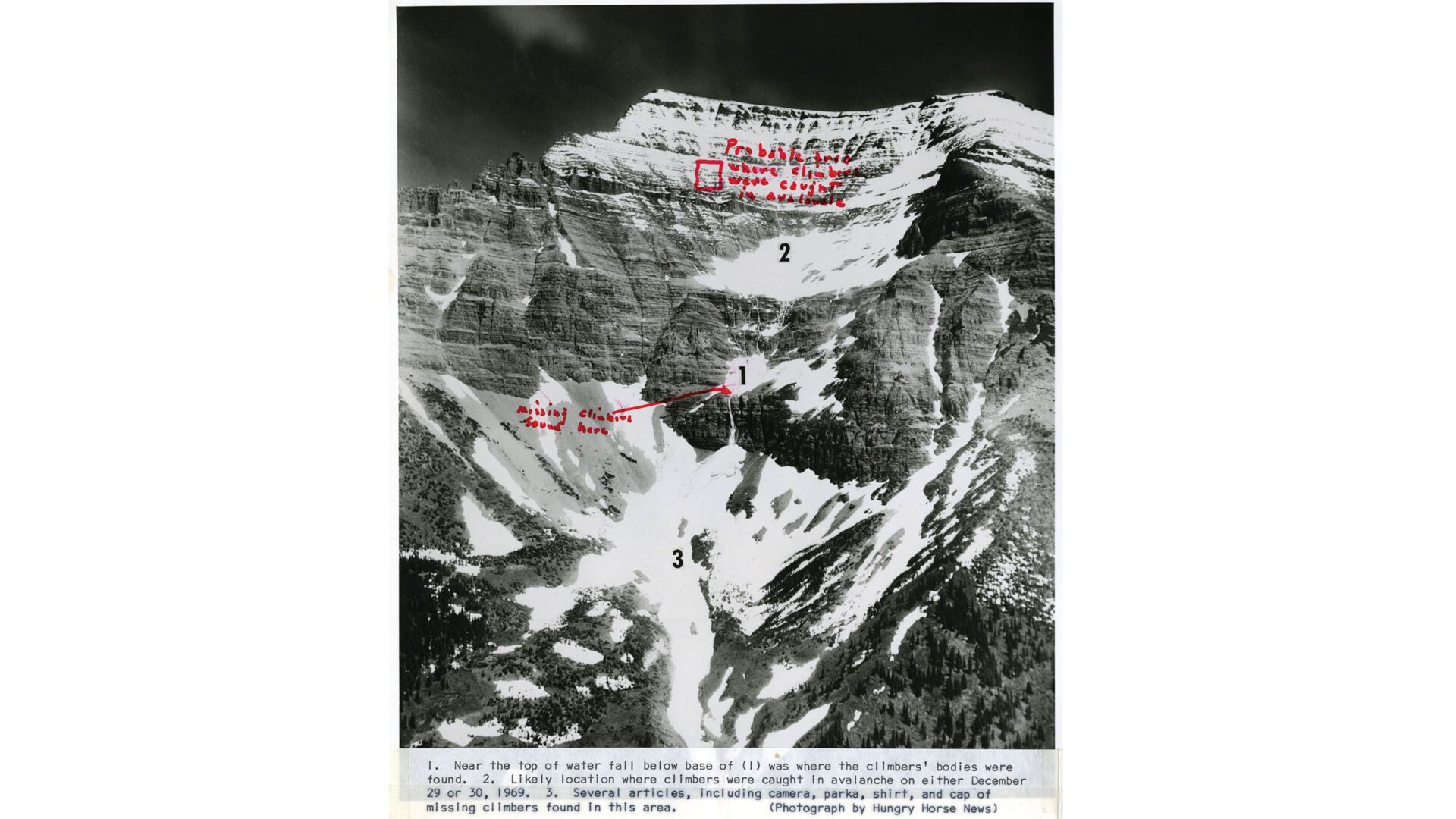
The hunt for the missing climbers resumed in May 1970, amid dicey conditions created by melting water, tumbling rock and snowslides. On May 29, searchers decided to climb to Cleveland’s summit following the route likely taken by the missing men. Well below the summit, in a bowl area just above a waterfall, they spotted a body with a red climbing rope still attached. It was Ray Martin. That same day, the searchers reached the body of Jim Anderson attached to a gold rope. Using photos recovered earlier from Anderson’s camera, the searchers suspected they would find Mark Levitan along the path of the gold rope, followed by Clare Pogreba. They believed Jerry Kanzler was linked by the red rope to Martin.
With shovels, Pulaskis, and ice chippers, and later using a system that tapped water from a nearby natural pool, the recovery team used a high-pressure stream to speed the removal of debris and snow more than 25 feet deep in places. On July 3, the searchers reached the remaining bodies and extracted them, along with the remains of Jerry Kanzler, who was, as his mother predicted, the last of the five to be ferried off the mountain.
The same day, in the Inter Lake, Glacier superintendent William Briggle, who flew in the helicopter that brought Kanzler’s body off the mountain, noted the sadness of the deaths but defended the right of the young men to climb. “If they insist, there is nothing we can do about it. They have the right to make that attempt,” he said. As for future adventurers, “We will try to guide them in making their decisions. And we’ll tell them the story of five young men and 188 days . . . perhaps Mount Cleveland can speak louder than we can.”
In the coming days and weeks, Jerry Kanzler was buried next to his father in Glacier Memorial Gardens in Kalispell. Mark Levitan was buried in Home of Peace Jewish Cemetery in Helena. Clare Pogreba and Ray Martin found their final rest in side-by-side graves in Butte’s Mountain View Cemetery. The ashes of Jim Anderson were spread over Mount Cleveland, fulfilling an “if anything happens” request he’d made to his family. The Anderson family, with the support of families and friends of the other climbers, built a monument memorializing the five men in Yellow Bay State Park, next to a small creek that trickles into Flathead Lake.
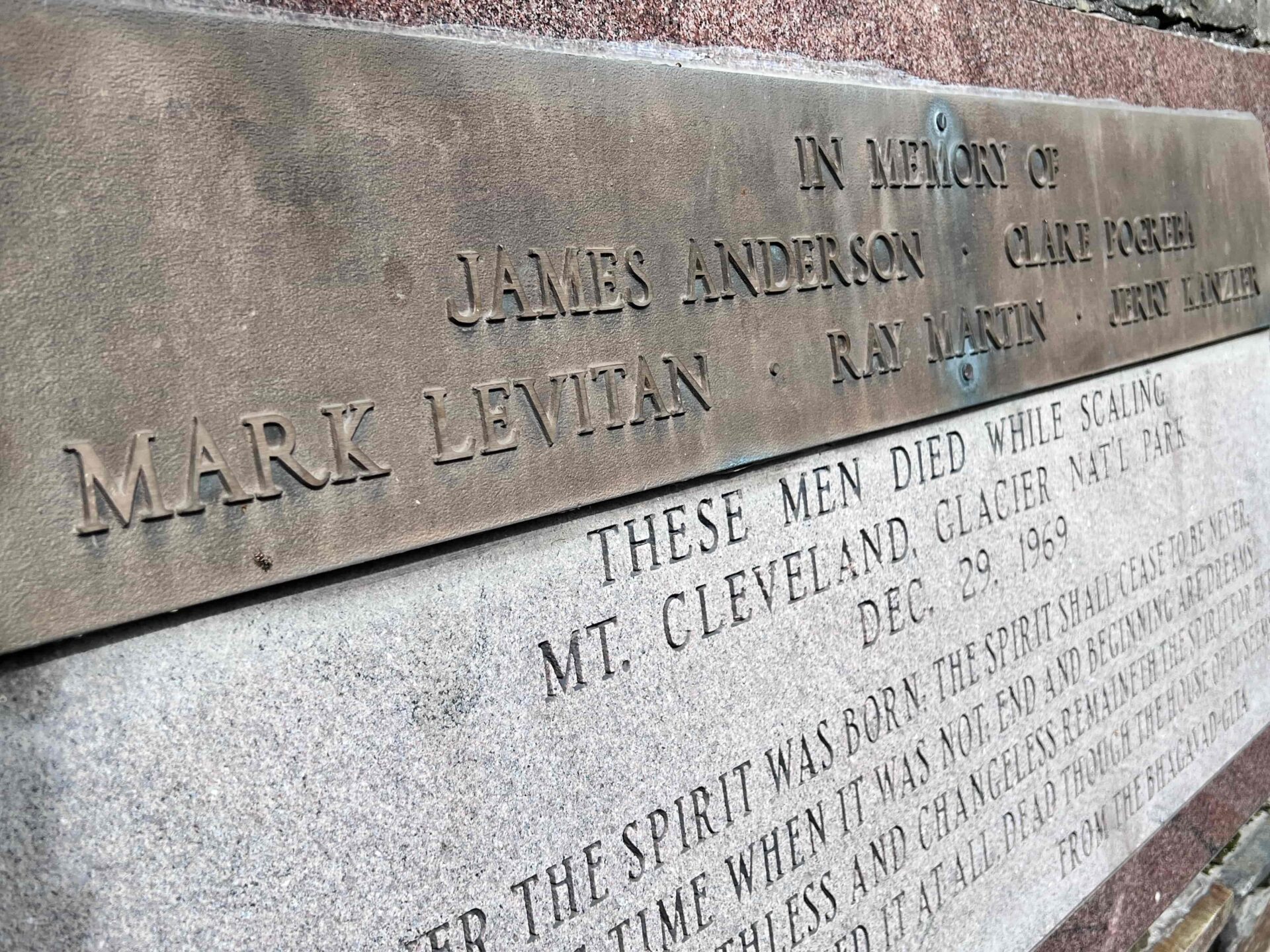
In 1976, Jim Kanzler, Terry Kennedy, and Steve Jackson became the first climbers to complete a full ascent of Mount Cleveland’s north face, propelled in large part by the 1969 tragedy. Callis said he would have liked to have joined the climb but was out of town. He had returned to Cleveland in 1970, not long after the bodies were recovered. He has not been back since. Recalling the invitation to join the ill-fated climb, he said, “I’ve often wrestled with the question of whether I would have died along with them,” adding that there are elements of the long-ago tragedy “that you can’t let go.”
The ill-fated Mount Cleveland climb is the subject of The White Death: Tragedy and Heroism in the Avalanche Zones, published in 2000. Author McKay Jenkins, a college professor who lives in Maryland, first learned of the Cleveland story in 1997 after attending a presentation by Frauson during a trip to Glacier. Working over two years, Jenkins dug into the lives of the climbers and their families to capture what he describes decades later as “a really indelible story.”
In 2017, Kennedy, a longtime Bozeman physical therapist who grew up in Columbia Falls near the Kanzler family, authored, In Search of the Mount Cleveland Five, chronicling the tragedy as well as a series of climbs with Jim Kanzler and others, including the 1976 successful Cleveland north-face ascent. Since then, Kennedy has climbed Cleveland four more times, conducting a personal investigation into the possible sequence of events that led to the climbers’ deaths. The official 1970 park report into the accident concluded that the young climbers were buried by an avalanche as they traversed the mountain’s west face well below the summit. The summit register retrieved by helicopter during the initial search didn’t include the names of the climbers.
Kennedy, relying on his recent climbs, the study of the entire series of Jim Anderson’s 30-some photos from decades ago and current images of the mountain, reached a different conclusion: “I think these guys reached the summit and were killed in the dark on the way down.” As for the summit register, he speculated the climbers had reached the top late in the day, were being pounded by wind and cold, and as darkness approached, chose to leave the peak quickly, forgoing the register.
The possibility that the climbers reached the summit admittedly offers little consolation to family or friends. Claiming the first winter ascent of Cleveland holds meaning in the mountaineering world, Kennedy said. Reaching the top would validate the effort and dreams of the young climbers.
While he still finds the deaths on Cleveland haunting, Kennedy says his investigation, more than five decades after the climb, has a practical motivation. “I decided somebody has got to do it, or otherwise the whole thing fades into nothing. It’s going to be lost to history.”
Butch Larcombe worked for 30 years as a newspaper reporter and editor and as the editor of Montana Magazine. His book, Montana Disasters: True Stories of Treasure State Tragedies and Triumphs, was published in 2021. His most recent book, Historic Tales of Flathead Lake, was published in 2024. He lives near Bigfork.