By Toby Thompson
The face is iconic, at age 75, beloved in its familiarity yet reflective of the diverse roles Jeff Bridges has played. Framed by a tousle of gray-blond hair, we see Dan Chase in the 2022 FX series, The Old Man, but also Rooster Cogburn in 2010’s True Grit, for which Bridges earned an Oscar nod, and deeper, Bad Blake in 2009’s Crazy Heart, for which he won the Academy Award. In his boyish grin, there are suggestions of the Dude in 1998’s The Big Lebowski, and even the Texas high-schooler Duane in 1971’s The Last Picture Show, for which he received his first Oscar nomination. In 1973, The New Yorker’s Pauline Kael wrote that Bridges “may be the most natural and least self-conscious screen actor who ever lived.” As his grin spreads, the youths he played in 1975’s Hearts of the West and 1974’s Thunderbolt and Lightfoot, filmed in Montana, are incandescently visible.
“Thunderbolt was my first trip here,” Bridges says, of the Clint Eastwood/Michael Cimino project, for which the actor, at 25, bagged his second Academy Award nomination. “I was knocked out, man. I was excited when I got that gig, because I thought, ‘Oh my God, I’ve seen pictures of Montana. So I thought, oh, I’m gonna buy a motorcycle. What a place to have a motorcycle! And I had a great time, where I’d ride all around. I fell in love with Montana that summer and wanted to live here.”

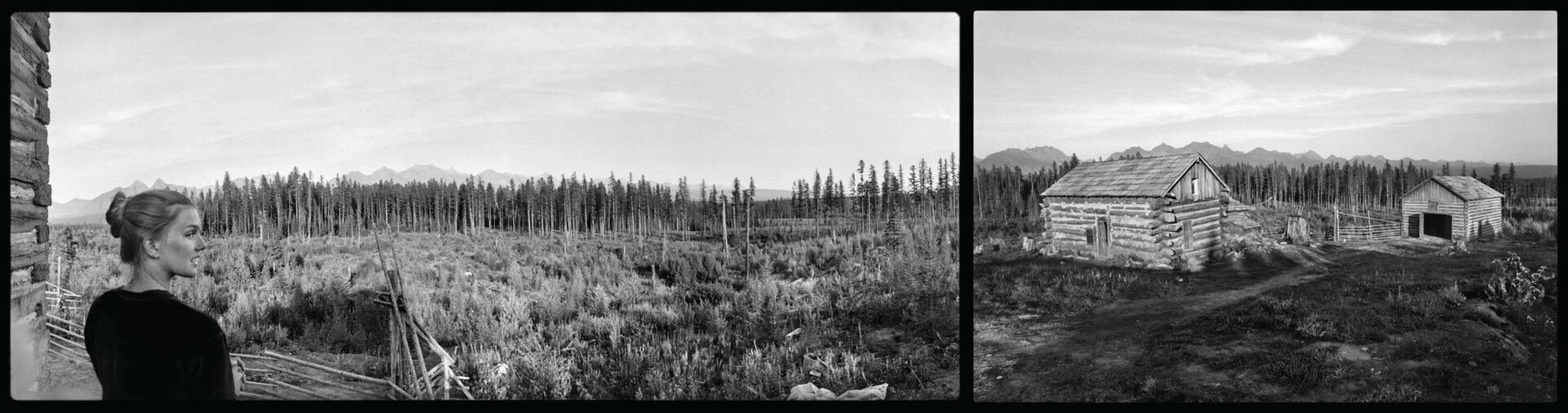
Bridges, in a navy short-sleeve and jeans, looks joyful yet slighter than he’s appeared in his more physical roles. The Dude has aged, yet he’s wonderfully gracious. He, I, and Rick Bass — the novelist, essayist, and environmental activist — are lunching at a picnic table in a yard overlooking the sizable ranch in Paradise Valley that Jeff and his wife, Susan, bought in 1979. That was prior to the filming of director Cimino’s third movie, Heaven’s Gate, shot near Glacier National Park. In that work, Bridges played a roller-skating-rink entrepreneur who is gunned down at the story’s finish alongside Isabelle Huppert, the madam of a log-cabin brothel. “Michael gave us that cabin,” Susan says. “We numbered the logs and trucked them down here.” Jeff nods toward the house behind us. “You can still see holes in the logs from where we were shot.”
The Bridges and their three daughters have summered here for 45 years. “I tell friends that my children were raised in a whorehouse,” Susan says. In 2021, both she and Bridges contracted Covid, Jeff after having been treated for non-Hodgkin’s lymphoma (“I had a 9-by12-inch tumor in my stomach”) while his immune system was compromised. He spent five weeks in a hospital’s intensive care unit. Both he and Susan wear oximeter rings, their ranch’s altitude measuring 5,200 feet. “I’m rockin’ 94 today, which is pretty good,” Jeff says. “Each time I come up, I’m better. I can sleep without oxygen things up my nose or walking around with a Darth Vader mask.”
Despite this, he looks discomfited. A pad with a list of discussion topics rests before him. “I was kind of anxious about this interview,” he says. “We were at the doctor’s and I thought, ‘I got to get prepared.’ I found I have a lot to talk about here, man, you know?”
Two of Bridges’ favorite causes are food security and preservation of the environment (he is co-founder of the End Hunger Network and is the national spokesperson for Share Our Strength’s “No Kid Hungry” campaign), and I’ve interrupted Bass’ questioning of him on those subjects to ask about Montana. His spread here is carefully managed “through regenerative ranching,” he says. “That means you’re environmentally sound with what you’re doing. One of my favorite quotes is from the Vital Ground guy, Doug Chadwick: ‘Do unto ecosystems as you would have them do unto you.’”
Bridges discovered Paradise Valley in 1974 while shooting the Frank Perry film, Rancho Deluxe, here and in Livingston. “Coming through Wineglass Gap, looking at that valley, I thought, my God. I want to live here.”
A compact bevy of artists — Thomas McGuane, who had written the screenplay for Rancho; the novelists Richard Brautigan and William Hjortsberg; the poet and novelist, Jim Harrison; the painter, Russell Chatham; the singer-songwriter, Jimmy Buffett; and others who lived in or visited the Valley regularly — were in residence. “It was like a dream come true. It was just community.”

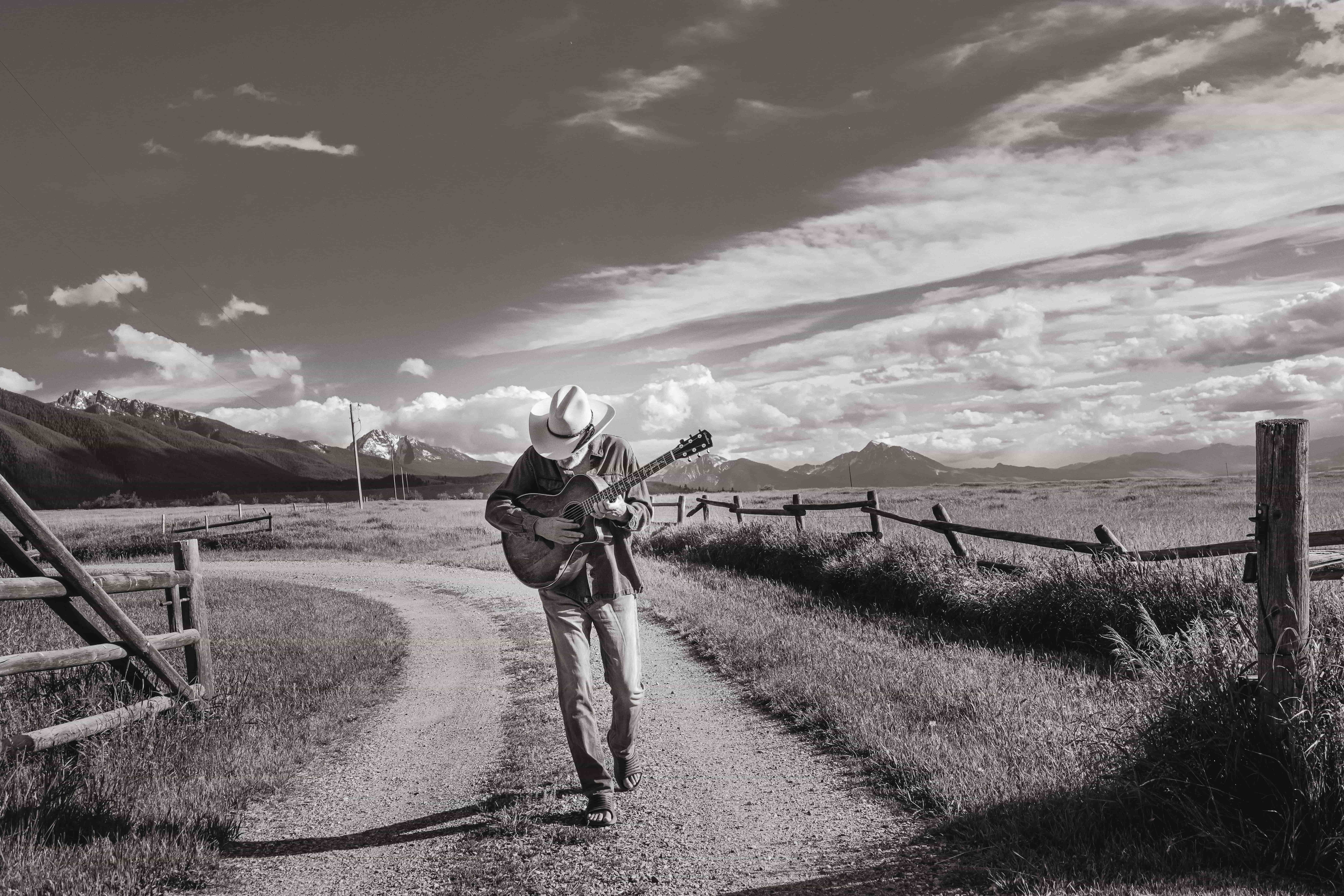
Bridges’ family business is show business — his brother Beau also acts, their mother, Dorothy, was an actress, and their father, Lloyd, appeared in more than 100 movies before starring in the hit television series Sea Hunt. Jeff, since boyhood, has created art in photography, painting, ceramics, and music, and in the ’70s had hung with a band of ne’er-do-well L.A. artists called The Gents. Last spring, he released an album of his and his friends’ largely improvisational music, Slow Magic, 1977-1978. “That group was different,” he explains, referring to the fellow artists who helped create the album. “Livingston is a small, tight little place.”
Its artists — older than Bridges, more established than The Gents, but no less wild — would eventually include the actors Peter Fonda, Michael Keaton, Dennis Quaid, and Warren Oates, the director Sam Peckinpah, and the actress, Margot Kidder, of Superman fame — who’d had one date with Bridges in California about 1970. “He brought his guitar and it was like he’d just stepped off a surfboard.”
In 1974, Livingston was also home to a young woman from North Dakota named Susan Geston, who was working at Paradise Valley’s Chico Hot Springs Lodge. Bridges — longhaired and hipsterish at the time — met this slight but lovely blonde on the set of Rancho. “We’re doing a scene with Harry Dean Stanton, Sam Waterston, and Richard Bright in the pool up at Chico. We’re sitting there, and I’m looking at this girl. I can’t take my eyes off her, so pretty, and she’s got a broken nose and two black eyes from a car accident. I get up the courage to ask her out, and she says, ‘No.’”
“I’m at some mosquito-infested place on the Yellowstone, and I get this wild feeling: I’m looking at this with my future wife.”
Bridges laughs. “Later, I asked, ‘Why did you say that?’ She said, ‘Well, you Hollywood guys come in here and think you’ll get all the local stuff. Forget about it.’ But then we met at the movie’s wrap party. We danced and it was like, you know, kind of a different thing.”
They had a date “looking at a property up here,” Bridges says. “I’m at some mosquito-infested place on the Yellowstone, and I get this wild feeling: I’m looking at this with my future wife. And this is our first date! I said, ‘Let’s get out of here.’ It frightened me. It was such a strong feeling, but here we are 50 years later.”
Rancho Deluxe would be one of at least 10 Westerns in which Bridges would star, a list that arguably includes his most famous role as the Dude, in Joel and Ethan Coen’s 1998 film, The Big Lebowski. Many forget that this L.A. saga is introduced by Sam Elliott, in his deep Western drawl, who — accompanied by “Tumbling, Tumbleweeds,” intones, “A way out West there was a fella, fella I want to tell you about, fella by the name of Jeff Lebowski … this Lebowski, he called himself the Dude.”
Lebowski felt unique in its outrageousness, but it might have been derivative: “I saw Rancho fairly recently,” Bridges says, “and I thought, this is a precursor to The Big Lebowski, man. You know, all these weird characters?”
Rancho, released in 1975, concerns two young friends, played by Sam Waterston and Bridges, who are rustling cattle in Paradise Valley. Waterston’s character is of mixed-Native heritage, but (jokingly) with aristocratic roots. “We’re supposed to have some royalty in there,” his father tells Sam, “the Prince of Angola or something.” Bridges’ character is an upper-class youth from California, who, when visiting his parents, is chauffeured from the airport in a Rolls-Royce. These characters are contemporary hipsters who wish to be outlaws. What McGuane accomplished in the comedy, Rancho, was to predict his generation’s contribution to gentrification in the Mountain West.
“Compared to when we were filming that,” Bridges says, “everything’s changed. Now with f*g Yellowstone, that TV show … they say it’s about Paradise Valley. It’s not Paradise.”
Nowadays, the Bridges live for most of the year in California. Jeff is asked about the concept of Montana as refuge. Does he experience it that way?
His expression softens. “It’s so different, man. It feels so different. We live in a beautiful place, Santa Barbara. Gorgeous. But when I walk in the creek bottom here, there’s something about it.”
Does he enter a different headspace?
“Yeah. There’s a certain bit of … I guess melancholy is a word that comes to mind, a disoriented feeling, because it is so different, you know? But the beauty is just stunning.”
From the age of 8, Bridges performed in his father’s and others’ contemporary TV shows. But he was enraptured by the classic Western. “My dad had been in High Noon,” he says. “He was kind of a bad guy. Gary Cooper had that fight with Dad under the horses. My brother Beau blew that scene because he was on the set that day. When Cooper threw a bucket of water on my dad’s face, Beau laughed and ruined the shot. (Beau, eight years older than Jeff, later would quip, “I taught my brother everything he knows.”) But yeah, I love Westerns. What an amazing time in our country, you know? I got to play Wild Bill Hickock in a movie, Wild Bill.”
That 1995 film bombed financially — unusual for a Bridges project — but three years later, the post-modern Western, Lebowski, would lend Bridges superstar status — the Dude being seen as a cultural mood ring in the wild west of bohemian night life (a majority of its scenes were shot after dark), the film spawning numerous books — including Bridges’ own — and Lebowski Fests, to which thousands would attend.
“Wild, those festivals,” Bridges says. “Just wild.”
Riding the success of Crazy Heart, in which Bridges played an alcoholic country singer, he released an album of Americana-style songs, toured with his band, The Abiders, and performed at the 2014 Lebowski Fest in L.A. The response was astounding.
“That was my Beatles moment,” Bridges says. “In the audience, you’ve got all these guys dressed up like bowling pins, and like Walter or the Dude. The guy who won the costume prize was dressed up as Jackie Treehorn’s doodle — that image with the boner, you know? It was very surreal. And the movie keeps having offshoots, like our book, The Dude and the Zen Master.” He points toward the yard. “Which was created right here.”
The phenomenon of the Dude abides: There is a Church of the Latter-Day Dude, and at least a dozen books have been published on Dude spiritual topics. They have titles such as The Dude De Ching, The Tao of the Dude, The Abide Guide, and The Incomplete Dudeist Priest’s Handbook. Bridges’ effort — The Dude and the Zen Master, in cahoots with Zen roshi, Bernie Glassman — appeared in 2013. Glassman visited Jeff at this Paradise Valley ranch and the two recorded hours of conversation about the Zen-like wisdom in The Big Lebowski, and about life in general.
The premise of the book is that Dude expressions are koans, Zen puzzles about the meaning and oft-times absurdity of existence. “It’s filled with ’em,” Glassman says. He spills out lines from the movie: “The Dude Abides,” “The Dude is not in,” “Donny you’re out of your element,” and the most famous, “That rug really tied the room together,” commenting that they’re classic Zen. Bridges in the book is aghast, but soon gets with the program, sketching his vulnerabilities in surprising detail.
He confesses to Glassman that he stuttered as a kid, still does, and often becomes anxious and has trouble expressing himself. Anxiety dogs him in movies, too. “How am I going to do this?” he says.
Such vulnerability is unexpected for a reader accustomed to the coolness of the Dude and other Bridges characters. As youths or in middle age, they are typically innocent, hip, but a trifle fey … tousled folks from the Golden State who nevertheless might erupt in anger or violence. In a recent New Yorker interview with Amanda Petrusich, Bridges said that his mother told him he had “something called abulia … It means not being able to make up your mind. It’s a mental illness called abulia.”
Until publicity hassles begin, he will hole up in his ranch studio or the whorehouse, writing songs, composing music for the Emergent Behavior series on his website, painting canvases, hiking in the national forest behind his property, or practicing yoga.
Bridges shrugs this off in The Dude and the Zen Master, but admits to Glassman that he fears committing to anything new, and wonders how he’ll accomplish it. Sue, however, reminds him that this is a pattern, and a conflict he usually resolves.
This pattern might account for his skittishness today. And part of his difficulty with commitment might have to do with his reluctance to persist with acting as a youth: “I was kind of thrown into my career at six months old,” he told Glassman. A friend of his father needed a baby for a film he was directing, so Lloyd said, “Here, take Jeff.” He would develop no desire to act; a career in his father’s shadow felt like nepotism. He wanted his own success: “Not because of who my father was. I wanted to do my own thing, and I didn’t know what that was because I was interested in so many different things.”
Such as music. As a teenager, Bridges played guitar and piano, had written 60 songs by the mid-1970s, and had a weekly jam session with his ne’er-do’well buddies. As critic Sam Sweet wrote in the liner notes to 2025’s extraordinarily wacko, but beautiful album, Slow Magic, for Jeff’s generation, “Music, not movies, was where it was at.” Also, for Bridges, was a need for the deep exploration of his own psyche. In 1977, during the genesis of Slow Magic and when shooting the movie, King Kong, he told Tim Cahill of Rolling Stone, “What’s frightening isn’t this big giant monkey. It’s everything I’ve ever feared in my life. It’s my mind.”
Explore his psyche he did. At University High, near UCLA, a guidance counselor named Caldwell Williams had created a program called DAWN: Developing Adolescents Without Narcotics. “Dopers, rebels, suicidals, and potential dropouts” enrolled. So did Bridges. “That’s where I met Jeff,” his best friend, the producer, David Greenwalt (of Buffy the Vampire Slayer renown), told me. “Williams was an unsung genius who saved a lot of high school kids’ lives. He saved mine.”
Greenwalt, who sang and played on Slow Magic, is finishing a documentary about Williams and his work. Part of his subject’s thesis was that secondary education had it wrong. Rather than encouraging competition in the classroom, Williams felt collaboration should be emphasized. “In academic classes, traditionally, one is on one’s own,” he’s said. “In the most successful school experience, one is collaborating with others.” This was a ’60s version of group therapy. Bridges found it bracing. It was so much like making a movie.
“The drug of choice in my high school was shooting speed, you know, methedrine,” Jeff tells me. “I was a pothead, though. Caldwell would have these marathons in the desert at this Benedictine monastery, going for three days with no sleep, man. (Greenwalt says that “Jeff grilled a monk about masturbation and sex.”) We would drink coffee and stay up. And, of course, you know, all of your defenses drop and you really get down to some interesting work pretty quickly without sleep.”
Sweet notes in his brilliant essay that, at Bridges’ first retreat, he “was overwhelmed with a profound wave of sadness. One of the other kids said, ‘That’s bullshit, you’re always so happy.’ The words sent Jeff into a convulsion he’d never experienced before.” He told Rolling Stone, “I was spewing laughter and sobs and shaking and I really didn’t know what it was.”
Bridges tells me that, “It didn’t keep me off pot, I got to say. So I don’t know how successful I was. But Caldwell did get me into talking about things that mattered, you know. It was good that way.” Sweet concurs that DAWN “didn’t completely curb [the group’s] drug use, but it did leave them with a taste for radical therapeutic release.” In Bridges’ case, this led to experimentation with LSD, sensory-deprivation tank therapy, cold plunges, EST retreats, and eventually Buddhism.
He also learned to acknowledge the trepidation that DAWN had uncovered.
“I think it had to do with fear,” he told Rolling Stone. “When you just don’t have the strength, then you have an opportunity to let off some of that stuff. And then you realize you can do that any time you want. That fear thing: You can cause it. That’s what acting is all about. If you realize you have fears, and define them, you win. I’ll always be deathly afraid. I use fear for my art, as fuel for my art.”
His middle daughter, Jessie Bridges, a singer-songwriter who has been his assistant on three movies and who opened for him musically during the Abider tours, says of Jeff’s anxieties, “My interpretation is that he knows suffering is not something you can escape. And so the sooner you can get with the program and accept that it’s part of the deal, the less torturous it is.”
Facing fear is expressed for Bridges, most poignantly, in the 1993 film, Fearless — considered by critics to be one of his more sensitive roles. He plays Max Klein, who, while traumatized by a vividly dramatized plane crash, transcends his fear of flying by, post-crash, fearing nothing. It’s a form of dissociation, but it has allowed him to save a child from the wreckage and be called a hero. After a nearly suicidal panic attack, by film’s end, he’s worked through his dissociation and can both experience and confront fear realistically.
“Obstacles are the way. They’re gifts, you know. You learn stuff that you can’t or wouldn’t learn otherwise.”
Jessie adds that Jeff’s “is the same fear that I experience, about going on stage. It truly feels like dying.” The trick to combat it is “feeling the fear before you go on stage. And then going on stage, you’re facing the fear of death. It’s right there, and you’re saying, ‘I don’t want to do this. My body’s reacting to it, my mind’s going crazy. This is really uncomfortable. But I’m gonna do it, and I’m going to see what happens.’ Then you get to the other side and you’re like, ‘Oh, that was the full experience. I didn’t die, you know?’”
Except, with Covid, Jeff nearly did.
Today in his ranchyard, beneath a sheltering tree and at the family picnic table, Bridges remembers that, in 2020, “before we were coming up to Montana, I’m on my back doing some exercises. I think, gee, it feels like a bone is in my stomach. Bones aren’t supposed to be there. I say, ‘Sue, come look,’ and she says, ‘Yeah, you ought to get that checked out.’ I say, ‘No, it doesn’t hurt.’ So, we go up to Montana, I’m having a great time, I’m feeling wonderful. My shins itch, and I’m having night sweats, but it’s summer. It turns out that all those things were symptoms of lymphoma.”
He was diagnosed, underwent chemo and with his immune system compromised, by January of 2021, contracted Covid. “He almost died 18 times,” Jessie told me. ‘They had the respirator there. They were going back and forth about whether or not they should intubate him, because they said at his age with his condition, if we do, the likelihood of him coming off the ventilator is very low. He lost something like 60 or 70 pounds in the hospital, came back completely atrophied and had to start building his muscle again. And then there was the breathing, so his lungs were really bad for a while.”
Jeff’s Buddhist training and practices that he’d learned from teachers like Glassman, proved essential. He told Tom Chiarella of AARP magazine, “The doctors said, you need to fight.’ I couldn’t understand how you’d fight it. So I fought by surrendering, which is not the same as giving up … What I really felt at the time was love … not only from the people around me, but also the love in my own heart for them. So what I did was more like giving in to love, you know?”
Susan appears with her dog, Monte (for Montana), a Cavapoo, which she introduces to Ada, a coonhound/Staffy mix belonging to Rick’s daughter. Sue’s left arm is in a sling, from a recent fall — one that dislocated her shoulder. Nevertheless, she says, “Let me show you the house.” We follow her inside. Jessie has told me that as a child, she saw her mother as the center of this and the California house’s hearths, and that during Jeff’s absences filming, “She played both parental roles. “Mom was the one who was there creating structure for us. Then, with our dad, he would come home and it would be thrilling and exciting, but fleeting because there wasn’t that consistency.”
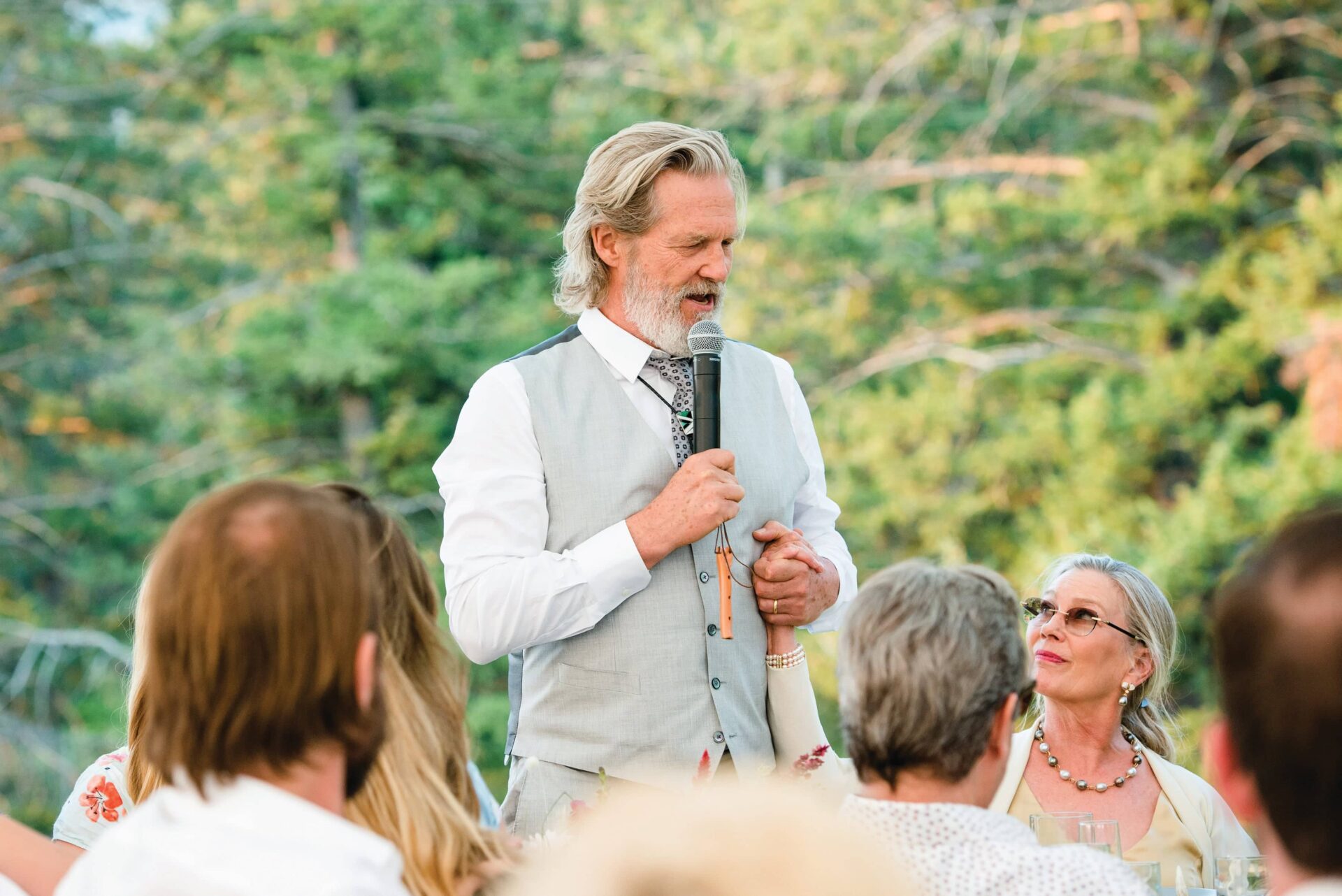
David Greenwalt, who, at 18, after his father’s death, became part of the Bridges clan, says, “Family is religion to the Bridges.”
What I see in Susan, here, is the girl whom, in 1976, friends and I accompanied to the Big Timber Rodeo, watching her climb atop a chute to photograph cowboys on broncs or bulls, and with whom I kibitzed at numerous parties during the 1980s, visiting this “whorehouse” or Peter Fonda’s ranch with Jeff, to play guitars or to schmooze. “Yes, we go back,” she says, smiling.
The whorehouse has been expanded since Heaven’s Gate, (for which she took stunning black-and-white photographs, exhibited at gallery shows), but its logs and original layout are intact, its rooms decorated with Jeff’s paintings — striking in their use of primary colors — Western sculptures and artifacts, the Montana gang’s books (“Brautigan’s Hawkline Monster, man!”) and Jeff’s guitars. I’m reminded of nights during the ’80s when we jammed at the Fondas’ on Indian Hill Road (Jeff singing Ringo’s version of “Act Naturally,” strummed National Resonators after a friend’s dinner party by the Yellowstone, or listened at a shindig at McGuane’s when rocker Warren Zevon pounded a piano, and group-sang at Jeff’s friend Donna Greenberg’s, on the South Fork of Deep Creek.
“In Malibu,” Jeff says, “Donna was instrumental in my life during that ’70s time of Slow Magic. Her house was like a center for the kids to come and hang out. She inspired all of us to be creative.”
The Slow Magic Bridges references is not just the title of the 1977-’78 album he released in April, but a lyrical incantation to oneness and of Buddhist peace of mind. The titular song goes, “Slow Magic comes and goes / You never think you’ll have it and / then it shows. It’s slow magic when you see how / the trick was done / Slow magic has begun.”
It’s a metaphor for the state Bridges finds key to creative inspiration, and indeed, happiness. He seems to have found both here.
“We’re all just doing the best we can,” he says, resignedly. Then pointing, “You’re the perfect Rick. You’re the perfect Toby. You couldn’t make a mistake, because you’re that guy.”
In the fall, he will appear as Kevin Flynn in “Tron Ares,” for “a small role” in film three of the Tron series he inaugurated in 1982. Until publicity hassles begin, he will hole up in his ranch studio or the whorehouse, writing songs, composing music for the Emergent Behavior series on his website, painting canvases, hiking in the national forest behind his property, or practicing yoga.
Professionally, he has little left to prove. Julianne Moore, his co-star in Lebowski, has said, “Jeff is just the most relaxed actor I’ve ever worked with.” Matt Damon says of Bridges’ acting in True Grit, that “Working with Jeff was like getting a masterclass.” And Maggie Gyllenhaal says about Bridges’ acting with her in Crazy Heart, “He’s the kind of actor who makes you better just by being in the scene with you.” Directors from John Huston to Peter Bogdanovich have praised him. David MacKenzie, who directed 2016’s Hell or High Water, says, “He’s like a sculptor — chipping away until what’s left is pure truth.” Robert Benton, who directed 2004’s The Door in the Floor, says, “He’s not afraid of dark places. He doesn’t shy away from emotional exposure.” Joel Coen, who directed The Big Lebowski, says, “Jeff is the Dude … He brought a humanity and casual brilliance to the role that made it iconic.”
Bridges’ health struggles seem largely past, but in December he will turn 76. Time may prove an impediment. Standing here, he says, “Obstacles are the way. They’re gifts, you know. You learn stuff that you can’t or wouldn’t learn otherwise.”
He gestures toward the magnificent expanse of green. “We’re part of it,” he says, “of this nature that just wants to live.”
Toby Thompson is the author of six books of nonfiction, including Positively Main Street, his biography of Bob Dylan, and Riding the Rough String: Reflections on the American West. He has written for publications as varied as Esquire, Vanity Fair, The New York Times, Outside, and Men’s Journal. His first job, in 1959, was as a ranch hand outside of West Yellowstone, Montana. He is a part-time resident of Livingston, and is an emeritus professor of English at Penn State University.