By Sula Castilleja Griggs
My first encounter with the grove was by chance—a quick stop to stretch my legs after driving across Lolo Pass, the mountain corridor connecting Montana and Idaho. I wandered the trails briefly, then returned to my car, unaware of the impact this place would come to have on me. On subsequent drives through the area, I always stopped to visit the tall trees. Slowly, those visits grew longer. I began to seek out the grove not just for its peace, its sense of scale, or its escape from modern life, but for something deeper. Over time, I realized the forest offered more than a moment of quiet. It held, in its stillness and enduring presence, a kind of roadmap to the person I was becoming.
I am a trans woman whose entire professional life has been spent in the federal service, dedicated to educating people about and protecting our most precious wild spaces. I began drafting this essay on January 20, 2025—the day Donald Trump took the oath of office for the second time, ushering in an administration that promised to be more aggressive and vindictive than his first. Professionally, I’m scared by the attacks I am already witnessing against public lands and public service. Personally, I’m terrified for the rights of myself and my community.

In times of great stress, I have always turned to the natural world. Now, more than ever, I find sanctuary in the land of the tall trees and absence of cell service. I find myself seeking places to disconnect and recontextualize my struggle. More than anywhere else, the DeVoto Memorial Cedar Grove has been that oasis.
Named for historian and conservationist Robert DeVoto, the grove lies just across the Montana-Idaho border. Along the rocky banks of the Lochsa River stand 2,000-year-old Western red cedars that have somehow escaped the sawman’s blade and fire’s flame. Their scratchy gray trunks reach skyward, and their canopies—arching 150 feet above—envelop the forest in a sort of twilight, much to the delight of ferns carpeting the floor. Walking among them feels like stepping into a place untouched by time.
Walking among these giants it is inevitable to, on occasion, come across one that has fallen. Every tree in this grove has stood a test of time, some just a bit less successfully than others. From small diameter 100-year-old trees to the rarer behemoths, each fallen cedar has its own story to tell. Of particular interest to me are the large diameter ancients who met their end in modern times, recognizable by their hollow bases.
Western red cedars, in keeping with their lengthy lifespans, do not die a quick death. In their final centuries, many fall victim to slow-moving fungal rot that eats away at their heartwood, leaving only a fragile ring of living sapwood to bear the weight of the years. Still, the trees might stand—hollowed yet upright—for several years, holding firm against the forces pulling them toward the forest floor. In their hollowed cores, I saw myself.
For those who have never questioned their gender identity, this may seem an abstract comparison. But to those of us who have, I’m sure you can see where this is headed. In those vestigial markers of cedars long since fallen, I saw nature’s manifestation of my gender dysphoria.
In their sterile, medical way, the psychiatric diagnostic manuals define gender dysphoria as an incongruence between one’s perceived sense of gender and one’s birth sex.
Popular media often reduces this incongruence to simplistic tropes—little boys wanting to play with dolls and growing up always knowing they wanted to be girls. The reality is rarely so neat, and ignores what many experience: an amorphous agony, building over years and decades of long-suffering silence until the day comes when the torment reveals enough to be granted a name.
I lived with this incongruence for 26 years before I figured out what was going on inside, and even after I came out to myself, to my friends, my family, and the world, I struggled to truly understand just what it was. One afternoon among these cedars I finally understood.
As I sat meditating in the bowl of a hollowed-out trunk, I envisioned myself as that cedar. For years upon years a fungus was eating away at my heart while my outer shell showed little of the turmoil inside. Every year, a new piece of my psyche gave way to the unstoppable fungus until just the husk of a man remained. Just as a cedar will eventually hit its breaking point and collapse, so did I.
Unlike those trees that anonymously fell sometime in the past, I can pinpoint my fall: December 2023, during one of the darkest months of my life. Again, I found parallels in the downed trees. The moment a cedar falls is not the moment it dies; it’s the beginning of a new phase.
I imagine that most people who visit the DeVoto Grove pay little attention to these fallen giants, or if they do, it’s only to navigate past them on the trail. But the more time I spend in the grove, the more I become fascinated with them. It is easy to be enchanted by the leviathans towering above, but it is harder to love the ones closer to the ground. As an informational wayside marker along the trail suggests, examination of the roots of one fallen cedar can reveal a network of roots of a new generation of smaller trees beginning their life as they cling to the scaffolding of their ancestor.
Even the trees that do not play host to such dramatic rejuvenation live on in some way. Through decades, the nutrients and molecules of that detritus will be returned to the Earth and continue the cycle of life, death, and rebirth that has spurred countless generations. Whether those molecules come back in the form of another cedar or in a different thing entirely is not immediately clear. Rather, patience is the chief virtue of forest succession.
I do not know what the future looks like for me now that I have toppled to the ground, but what I do know is that the cycle will not stop. Something new is coming. Will the conditions be right to prosper into something better than what I left behind? Those are things that I cannot know now. Throughout the last year, I’ve begun forging my own trail into this dark, foggy forest. From the hormones I take daily to reshape my body, the surgeries I’ve begun saving for, and the daily challenge and joy of recontextualizing the ways I move through the world around me, the path before me is becoming increasingly clear.
I hope that I can find a place in this world I’m finding both increasingly hostile and beautiful. I hope that one day, I will stand again in this grove of cedars I’ve come to know so well, and that they will know me as one of their own: someone who has weathered the tests of time, fallen, and been reborn as something new, shaped by what was, but more closely aligned with who I’m meant to be.
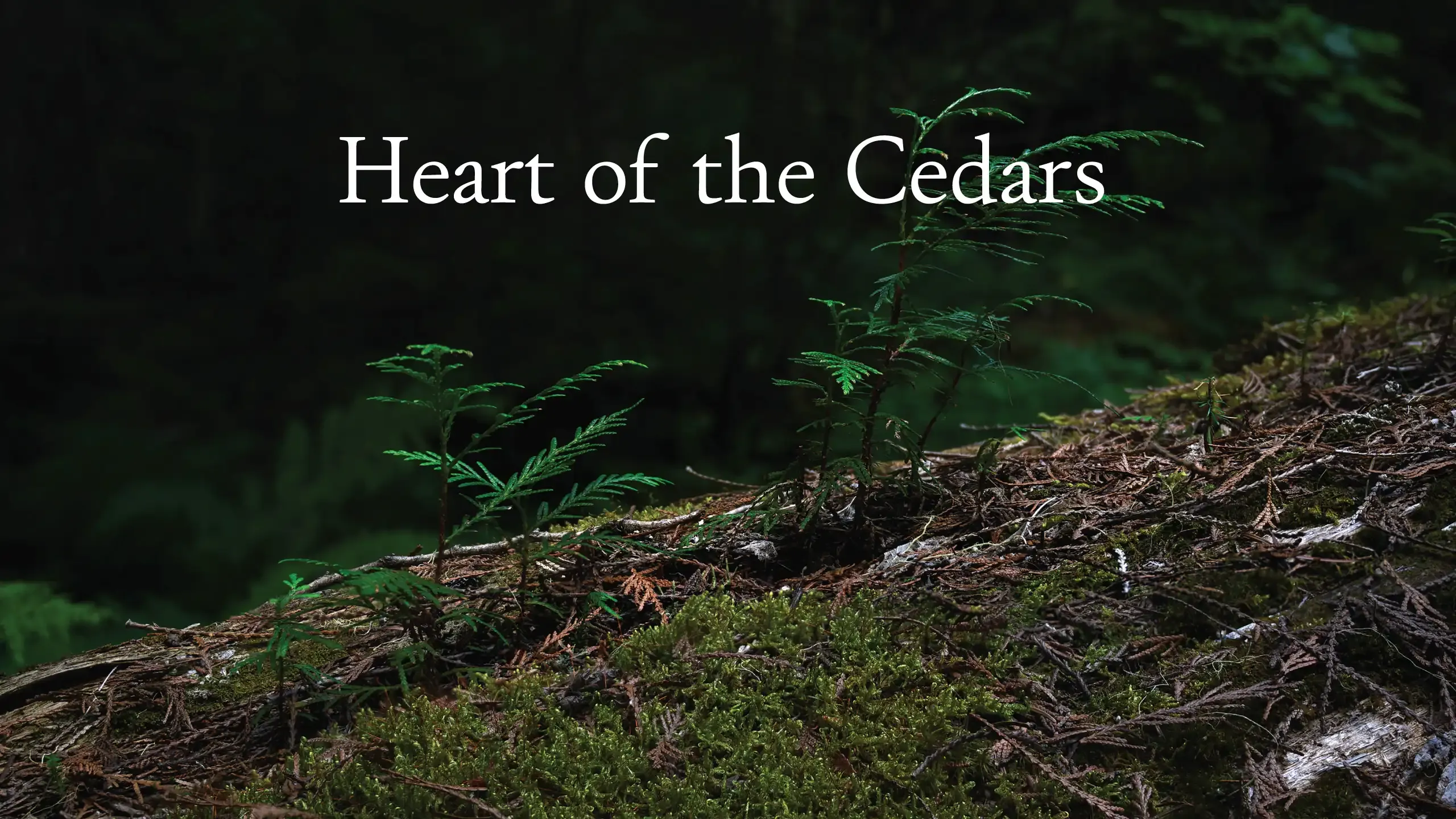
On my most recent visit to the grove, I made it a point to keep my eyes cast down. I did not want to focus on the growth of the past—I wanted to see what was coming next. In my downcast gaze I followed the ribbons of bark of a fallen tree until I found, among the debris, a few saplings no more than 6 inches high poking out through the leaf litter. When I return, they will have grown—and so will I. Years from now, perhaps they’ll stand a foot high, maybe two. I hope they’ll recognize my footsteps on this land, even if the form in which I return has changed.
Sula Castilleja Griggs (she/her) is a Missoula-based photographer, writer, and former park ranger.