By Rick Bass
Physicists tell us that sound waves, once initiated, are never completely stilled, but remain in motion forever, trembling with ever-decreasing but never-ending oscillation at the sub-atomic level. That musical instruments, famously, hold within them eternally the vibrations — the sounds — of every song they’ve ever played.
Next summer, an intrepid band of students from Maine will drive around the country with a Black Ram guitar in the front seat. During the 250th anniversary of the United States, they will pioneer a path they call the “Green Curtain” — a loosely-linked series of carbon-storing old-growth forests along the northern tier of the United States. They’ll leave the coast at dawn on the 4th of July and travel from one old forest to another — across Vermont, Michigan, Minnesota, and Montana — mapping a permeable curtain of green: a fringed, frilled, living, breathing organism, absorbing the world’s heated exhalations and preserving biodiversity. Along the way, they’ll teach the guitar — 315 years a tree, but now barely three years a guitar — the songs that matter most to us as a society. And when they come to Montana, our artists will receive them, and show and share with them the best we have: the open spaces that inspire our art and our lives. As they work with the map library department from their university, they will witness and chart a new American geography: Little Bighorn, Big Sandy, Big Sky, Bigfork, Big Arm, the Big Belt Mountains, and the American Prairie country along the Musselshell. Finally, they’ll reach the most northwestern corner of Montana, an ancient garden in the Yaak Valley that has launched their journey, and the place from which the music is coming. They’ll trailblaze a protected Curtain of Green, a map for navigating the next 250 years, and climate justice.
Whether predetermined pathways exist, written in stone, non-negotiable beneath our feet, or whether we have the freedom to choose and shape our destinies, is a matter for philosophers and theologians.

Sometimes there’s a man, and sometimes there’s an idea. And sometimes there’s a man and an idea. And, well …
It was a long and winding road that led that one certain piece of wood, which would become the Black Ram guitar, to Jeff Bridges, just as it was a long and winding road that led Jeff from California to Montana, more than a half century ago. He had a part in a movie filmed near Chico Hot Springs. It’s where he met his wife, Susan. Montana can just get into a person’s blood, and it’s an especially wonderful thing to see it do so in a young person, with so many years still ahead and such verve and vim. Jeff and Susan augured in, buying a place in Paradise Valley long before it became what it is; they knew beauty when they saw it. They disassembled an old cabin that was used on the set of another movie they’d worked on, Heaven’s Gate, up in the Flathead. They trucked it to Paradise, reassembled it on their land, moved in, raised a family and, by the side of a rushing, burbling creek and a grove of quaking aspen, lived happily ever after, taking refuge there when they could. When they can.
In Montana, Jeff and Susan have become powerful advocates for William Shore’s Share Our Strength program, working for more than five decades to strengthen food security for children. Susan was a founding board member of Vital Ground, an organization that has protected upwards of a million acres of private land in Montana, with a focus on critical habitat for grizzly bears. Jeff has also provided voiceover for documentaries by a nonprofit group, Save the Yellowstone Grizzly and, more recently, participated in efforts to protect an old-growth inland rainforest in northwest Montana’s Yaak Valley — in the region known as “Black Ram”— as the nation’s first Climate Refuge. Identified recently by Dr. Dominick DellaSala and his team as a premier climate refugia, the public land lying north of the Yaak River and south of Canada — approximately 275,000 acres — is a prime candidate to become a Climate Refuge: a place dedicated to storing maximum above-ground carbon in the long-term safekeeping of ancient forests, and to provide a focal point for increased scientific as well as artistic inquiry. Jeff is tireless, really, except he’s not. After surviving Covid and cancer, he needs — craves — some downtime, even as his brain keeps whirring.
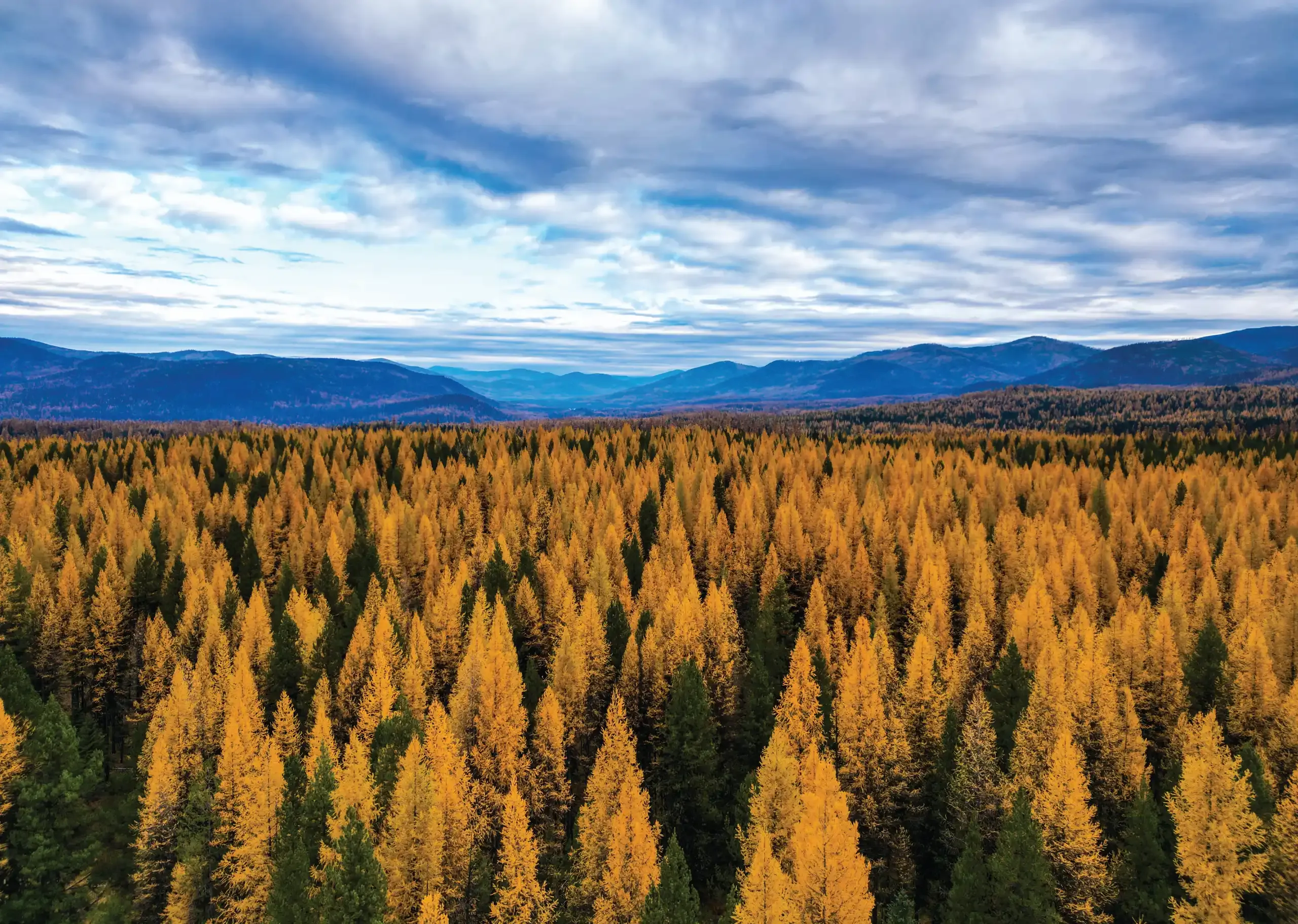
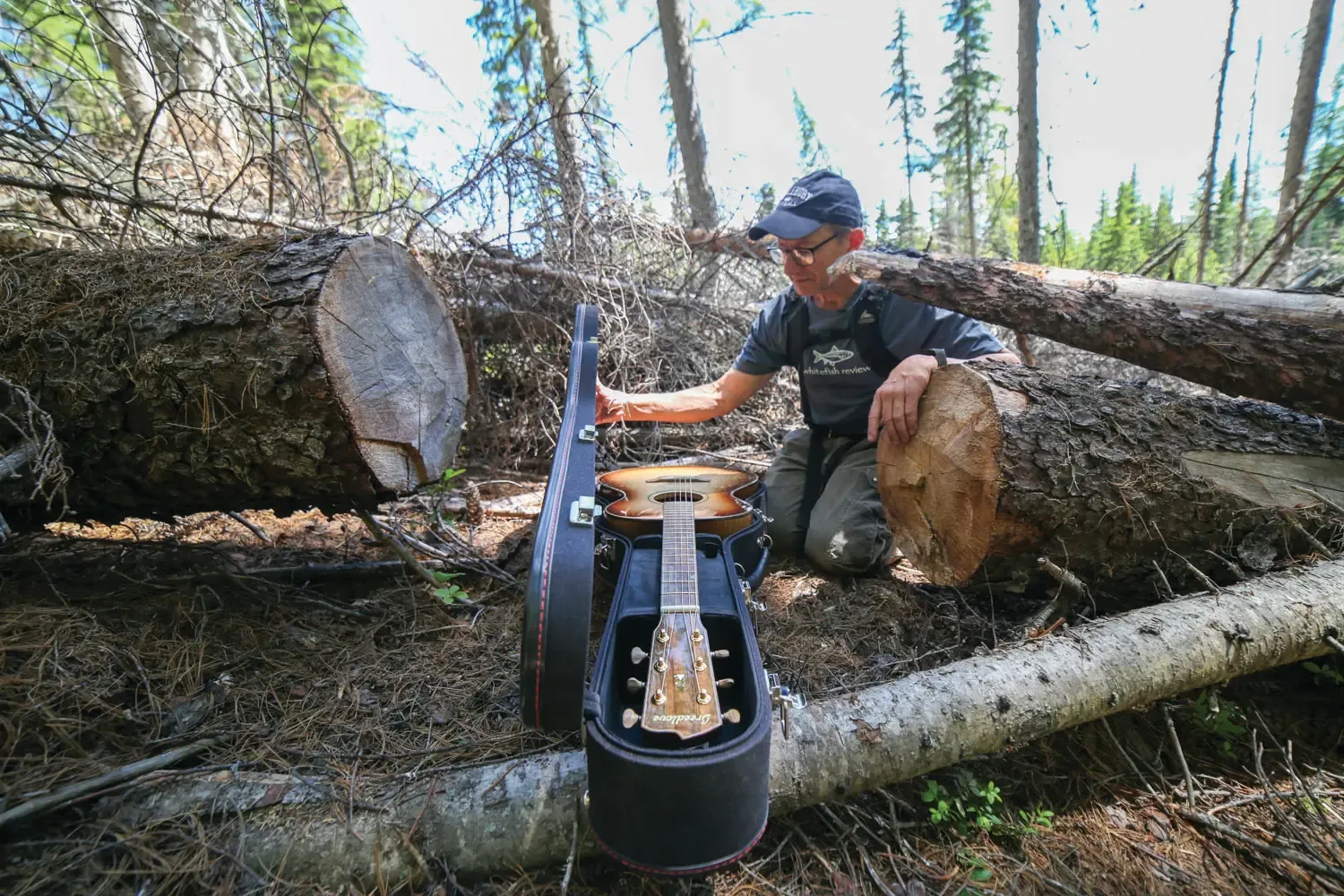
It was luck, not choice, that led him to hear the first Black Ram guitar. A craft guitar made by Master Luthier Kevin Kopp of Bozeman, the instrument used a piece of 315-year-old Engelmann spruce for its rich and resonant top, salvaged from an illegal logging sale on the Kootenai National Forest. An arts and conservation group I work with —The Montana Project — had the guitar made so that she, the guitar, could advocate for the old forest from which she came, which the U.S. Forest Service has threatened with hundreds of acres of clear-cutting in the wettest, most northwesterly region of the valley. Poet laureate Ada Limón and Montana’s Chris Dombrowski, along with Beth Ann Fennelly and Jane Hirshfield, have visited and written poems about the old forest. Painters Monte Dolack and Clyde Aspevig have captured it on canvas. Rob Quist has written a song for the guitar, salvaged and crafted from one of its trees.
Another group I work with, the Yaak Valley Forest Council, is bringing independent scientists to the Black Ram Forest to study its mysteries.
We hope that by being managed as a Climate Refuge, the Black Ram region will become part of a loosely linked series of other old and mature forests along the northern tier, forming a biodiversity-preserving, carbon-storing, and moisture-holding Green Curtain. Old big trees store more carbon than smaller trees, and they absorb it at a much faster rate, sucking it up, as if telling the heated world to slow down, to chill, to abide in the cool shade of the old forest.
Now scientists creep through the refuge on their hands and knees in slow motion, measuring the health of the forest’s thin soil, which is made up more of rotting carcasses of the giants who came before them, rather than true soil. As if the fallen and the moldering are still not yet fully done living. The scientists are studying the matrix of decaying organic material from which the guitar’s old forest emerged, and still emerges daily. They’re measuring its mycorrhizal activity and comparing it to that of nearby clearcuts.
Dr. Dominick DellaSala recently completed an Ecosystem Conservation Assessment for the entire Northern Rockies, including a detailed analysis of the Yaak River watershed. His team’s findings revealed two key metrics: that the Yaak will retain a greater percentage of its precipitation than other valleys, and that over the coming decades, it will remain the most fire-resistant, with an ever-increasing percentage of canopy cover — cool, moisture-retaining shade. A place in which to take refuge. A climate lifeboat.
Jeff asked me. “What does the word refuge mean to you?” To me, it’s not far from the Spanish word querencia — a place to retreat to, and a place from which one draws one’s strength — but I also think refuge can be more basic than that: a place to take shelter, particularly in a storm.
No designation exists yet for a Climate Refuge, but we think that’s a good thing: We get to create it as we go, easing inexorably into a burning future. One way to think of it is this: a place dedicated to storing the maximum amount of carbon and biodiversity in the long-term safekeeping of old and mature forests, while serving as an area for increased scientific and artistic inquiry into the effects of climate change on sensitive species, including our own.
When the painter Clyde Aspevig first came into the old forest, traveling over from his longtime home on the east side of the Divide, the first thing he did was stop and look up at the myriad layers of canopy and exclaim, “This is where the prairie comes from.”
The prairie grasses, begging for water, adapt and yield from that paucity, that hardship, their own incredible ecosystem. The two are connected as if at the hip. We are all in this together.
What does an ancient inland rainforest look like, and why does it matter?
It looks like a beguiling mix of shade and sun, as if the columns and rays of light are musical notes made visible. Enormous cedar trees with broad fern-like fronds keep the forest floor cool, as do the equally large hemlock trees. It looks like towering sun-loving thick-trunked fire-resistant larch standing shoulder to shoulder with the cedar and hemlock: different forest types that should not be able to tolerate one another, but which are not only co-existing, but prospering.
The immense centuries-old larch stands in a vertical fissure of light, growing out of the hearts of the giants that have fallen, and keep falling, throughout time: Each of the trees getting what they need, while beneath the surface, there are conversations we cannot hear, about how to keep old forests old and healthy.
The old forest appears chaotic at first, but after only a few minutes, you realize it all makes sense; everything is in order, as it should be, in a steady, dynamic motion.
As Clyde Aspevig notes, the Yaak’s rainforest makes Montana’s prairie. The old forest at Black Ram strains moisture and makes big trees, which absorb immense volumes of carbon and store it for centuries. This helps slow the rate of the great burning of the Anthropocene. On the east side of the state, the old forest at Black Ram gives our farmers and ranchers a chance. Gives our ski hills a chance, and our lovely rushing rivers, and our cold trout, a chance. Gives Montana a fighting chance. The old forest at Black Ram keeps cool things cool.
Right on, the Dude says, as I tell him of the refuge, and what the word means. Right on, he says. Don’t take no for an answer.

Late in life — having survived much — Jeff’s wandering path led him back to the Flathead, where it — this second part of his life, the Montana part — began. The state where the seed was planted. A literary journal, Whitefish Review, featured Susan’s photography from the set of Heaven’s Gate and hosted a launch party. The Black Ram guitar was there, played by Badge Busse and others. The Dude showed up, heard the story of how she came to be and what our hopes were. After the party, he played a few songs on her. He said he “dug the concept,” and within the same month, had commissioned six more Black Ram guitars with his signature on them from Tom Bedell. They were crafted using only domestic wood, as part of Jeff’s sustainability campaign, entitled “All in This Together” — a phrase Dave Matthews shared during his Wildlands concert in Big Sky. The campaign encourages people to consider not only where the wood in their guitars comes from — that it be domestic, and sustainably harvested — but to consider all the other wood in their lives — floors, frames, cabinets, etc. — and beyond that, their other choices as well.
In Montana, as in the old forest, there are connections between us that we cannot see. Some of us live amid bounty, even excess, while for others of us, there are times when there is winter in our blood. Just because you cannot see a thing does not mean it’s not there. Translucent underground billion-mile-long networks of mycelia, glowing like fiber optics just beneath our feet, with pretty much all the secrets of the world within, and a buzz, a whisper, we cannot hear, but sometimes — in the old forest — can begin to sense. And are stilled, calmed, in that presence.
Next summer, the students from Maine will arrive. Montana’s arts community will welcome these climate ambassadors by sharing our wild landscapes and then taking them into the old forest to make art, and to hear the silent thrumming symphony of all the trees around them — the old and the young, the fully healthy and the gloriously senescent, the straight and the crooked, the light-loving and the shade-loving: into the swarming diversity, toads and wolves, salamanders and grizzlies.
We will celebrate and nourish the students’ youth, curiosity, and hunger. We will teach them what we want them to learn. And then we will send them on their way, with a bit of Montana in their hearts, and a bit of Montana in their blood. The memories trembling, forever.
And then they will go home, share their stories and art, like ripples widening in a pond, like growth rings for the next 250 years.
It may take a long time for the students’ stories to become embedded in our country’s consciousness and inform our nation’s next genesis, transforming future generations. But that’s another lesson that the old forest, and her guitar, have shown us: that the strongest fiber comes from that which grows the most slowly and has experienced — and survived — the most challenges.
The sound — the music — such a struggle makes is exquisite.
Rick Bass is the author of more than 30 books of fiction and nonfiction. He’s Executive Director of the Yaak Valley Forest Council, and teaches creative writing workshops around the country (rickbass.net) including in the Stonecoast MFA program.